EV charging payments · Any provider · Direct settlement

Your charging network. Your bank. No middleman.

Romevo is the payment layer between an EV charging network and the money. Connect the acquirer, PSP or payment terminal you already use — funds settle straight into your own account, and drivers just tap a card.

How a charge gets paid

  1. Driver taps a card contactless · no account
  2. Payment terminal pre-authorization hold
  3. Your acquirer or PSP capture · confirmation
  4. Your account settled directly

Romevo orchestrates and reconciles every step — the funds never pass through us.

OCPI 2.3 Payment terminal & PTP roles, native
EMV contactless Tap to charge — no account required
10 currencies EUR · RON · BGN · PLN · CZK · HUF · CHF · GBP · USD · MDL
€0 Romevo transaction fee — we don't touch the money

The payment subsystem

A charging session is a payment that happens to deliver electricity.

Charging is the easy half. The hard half is authorizing an unknown amount before a driver plugs in, metering what they actually use, capturing the right figure when they unplug, and proving all three to an acquirer, a tax authority and the driver — every time, at every terminal, in every currency. That's the subsystem Romevo is built around.

  1. Pre-authorization

    The terminal reserves a ceiling on the driver's card before any power flows, so a session can never end in an uncollectable amount.

    preauthorize_amount — set per tariff, not per network
  2. Authorization

    The card, app token or RFID tag is resolved to an authorization the charge point will accept, and the session is bound to a correlation ID that follows it to the end.

    AUTH_REQUEST · COMMAND · WHITELIST → correlation_id
  3. Metering

    Every meter sample from the charge point is stored against the session, so the final figure is reconstructable rather than asserted.

    MeterValues — measurand, unit, value, timestamp
  4. Cost assembly

    When charging ends, energy, time, parking and reservation costs are assembled into a charge detail record against the tariff that was live when the session started — with tax handled explicitly, not inferred.

    total_energy_cost · total_time_cost · total_parking_cost · tax_included
  5. Capture

    The pre-authorized hold is captured down to the real amount. The acquirer returns a Financial Advice Confirmation, matched back to the session by correlation ID — the moment money and energy are provably the same transaction.

    FAC → capture_status_code · eft_data
  6. Receipt & reconciliation

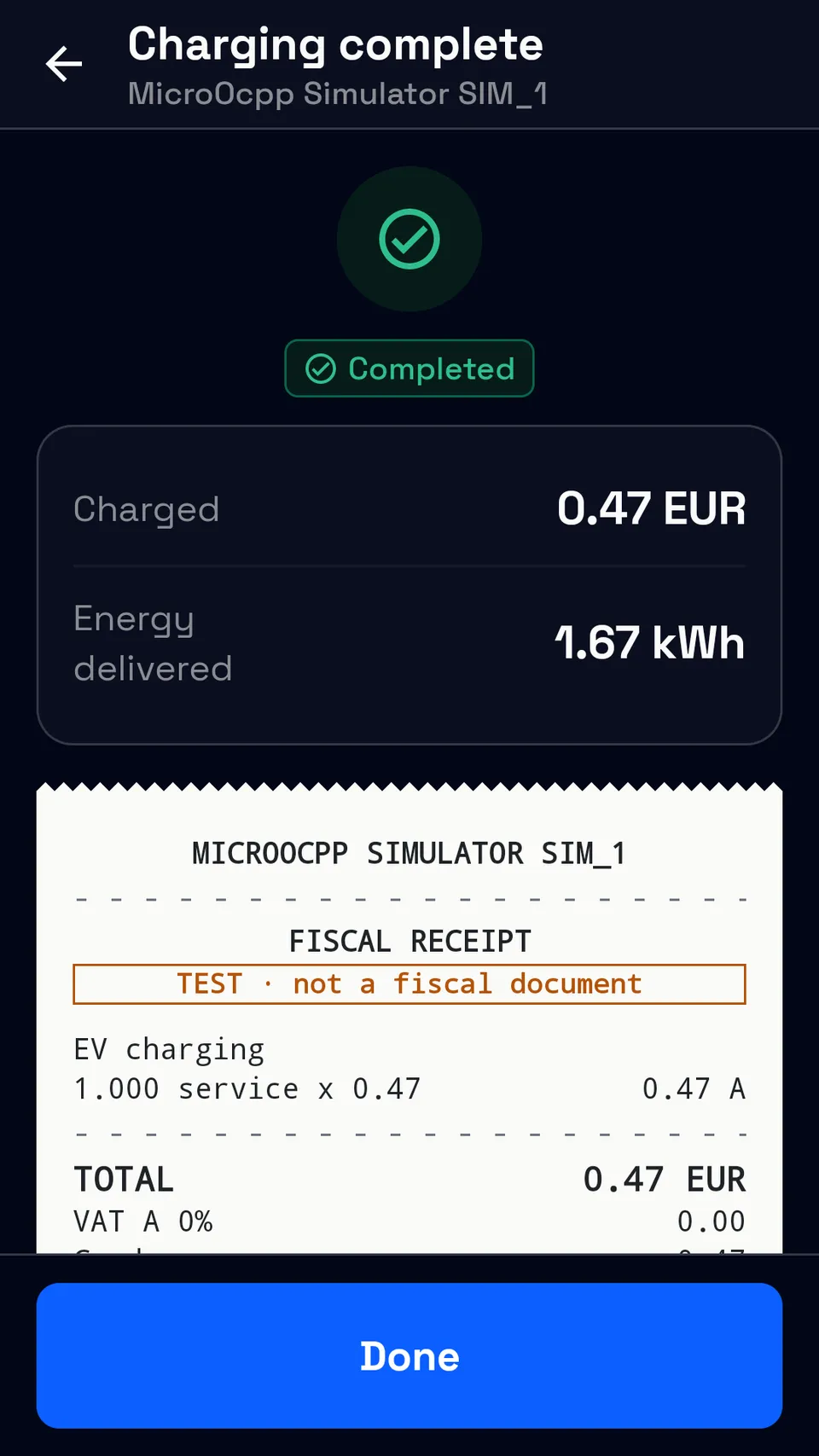
    The driver gets a receipt at a public URL the terminal itself issues. The operator gets the session, the record, the capture status and the invoice in one row of one table.

    invoice_base_url · invoice_creator: CPO | PTP

Most platforms model payment as succeeded or failed. Real acquiring has a third answer.

A capture can come back partial — the hold was 200 RON, the session cost 187.50 RON, the acquirer confirmed 170.00 RON. Romevo stores that as PARTIAL_SUCCESS with the confirmed amount and the acquirer's status message, surfaces it as its own filter in the operator's invoice view, and never silently rounds it into "paid."

Sessions that stop because a pre-authorization ceiling was reached are recorded the same way — InsufficientBalance and ReachedMaxCost are explicit stop reasons, not generic errors.

Success Partial success Pending Failure

Romevo handles

  • Pre-authorization amount, per tariff
  • Session ↔ payment correlation
  • Meter values and cost assembly
  • Capture request and status handling
  • Refund and credit-note records
  • Receipts, invoices and partner reports

Your bank, acquirer or PSP handles

  • Card authorization and 3-D Secure
  • Cardholder data, PAN and tokenization
  • Capture, clearing and settlement
  • Chargebacks and dispute handling
  • Funds transfer to your account
  • The merchant account and acquiring contract

Card data never enters the Romevo platform. We hold the session, the amounts and the acquirer's confirmation — not the card.

Where the money goes

Straight to your account. Not through ours.

Romevo never becomes a stop on the payment route. Your acquiring relationship stays yours — your merchant account, your contract, your rates. We orchestrate the transaction and reconcile it; the funds go where they were always going.

Driver's card contactless Payment terminal pre-auth hold Acquirer / PSP capture Your account settled tap authorize settle Romevo orchestrates · reconciles · never holds funds

No platform transaction fee

We don't take a percentage of a charging session, because the session's money never passes through us.

Your rates, your contract

Whatever you've negotiated with your bank applies. Changing acquirer is a configuration change on our side, not a renegotiation.

Full visibility of the flow

Every session carries its capture status, confirmed amount and acquirer message — so "did this get paid" is a column, not an investigation.

Payment providers

Bring your own payment provider.

Acquiring bank, payment service provider, unattended terminal, or all three — Romevo's payment layer is built to sit behind whichever you already work with. Adding a provider is an integration, not a platform migration.

Payment · Acquiring bank On request

Acquiring banks

Route charging revenue into an account with the bank that already holds your merchant relationship. The acquiring contract, the rates and the settlement cycle stay exactly as they are.

  • Scope Direct acquiring, pre-authorization and partial capture, 3-D Secure, refunds
  • Fit Operators with an existing corporate banking relationship
Payment · Service provider Integration-ready

Payment service providers

Card acceptance through a PSP, for operators without a direct acquiring contract. Holds, partial captures and refunds behave identically to a bank integration from the platform's side.

  • Scope Hosted card acceptance, tokenized repeat payments, payout scheduling
  • Fit Networks scaling before a direct acquiring relationship makes sense
Payment · Payment terminal Live in testing

Unattended payment terminals

Certified card terminals mounted at the charge point, running ad-hoc payment for drivers with no account. Currently deployed against the PAX IM30 in our test network.

  • Scope EMV contactless, chip & PIN, QR receipt issuance, tariff-driven pre-auth
  • Fit Any public charge point subject to ad-hoc card payment requirements
Payment · Driver wallet Live

Driver apps & roaming

The Romevo Android app for saved payment methods and session history, plus OCPI roaming so drivers arriving from another network settle through the same reconciliation pipeline.

  • Scope App-initiated sessions, stored payment methods, cross-network settlement
  • Fit Operators running a branded driver app or an e-MSP relationship

Full visibility of the money flow

Every session carries its authorization, capture status and confirmed amount, reconciled against the charge detail record. Payment state is a field, not a support ticket.

Security stays where it belongs

Cardholder data is handled by your provider and its certified hardware. Romevo receives the confirmation, never the card.

Nothing for the driver to learn

Tap, charge, and get a receipt. No account, no app download, no registration step between a driver and a charge.

Provider categories reflect the integration classes the platform supports. Specific provider names and logos are published only where a relationship is in place.

Certified payment hardware

Payment terminals built for a car park in February.

Unattended payment means hardware that survives weather, vandalism and a driver who taps once and walks away. Romevo runs on certified unattended terminals — currently the PAX IM30 in our test deployment.

200,00 RON Hold placed · tap to start

PAX IM30 · unattended terminal

PAX IM30 — key specifications
Display5″ colour, auto-activates as a driver approaches
PaymentEMV chip & PIN, contactless, 1D/2D code scanning
CertificationPCI PTS 5.x / 6.x, EMV compliant
Operating systemAndroid 7.1 / Android 10
Connectivity4G Cat 4, HDMI out for a secondary screen
EnvironmentIP54–IP65 / IK08, UV-resistant, −20 °C to +70 °C
Camera2 MP front + 2 MP scanner (Android 10 models)
01

The terminal knows the tariff. Pre-authorization amount, currency and pricing come from the tariff assigned to that connector — not hardcoded on the device.

02

The terminal issues the receipt. Each terminal carries its own receipt base URL, so the QR a driver scans resolves to that session's live receipt.

03

The terminal is inventory. Terminals are managed objects — location, activation state, site assignment, party ID and country code — visible alongside the stations they serve.

For drivers

Three ways to pay. None of them start with "download our app."

The fastest charging payment is the one a driver already knows how to make. Romevo supports contactless card, QR code and app — with ad-hoc pricing that means no account is needed to charge.

Tap a card

Contactless EMV at the terminal. A hold is placed before charging starts, and the real amount is captured at the end.

No account

Scan a QR

Scan the code at the station, pay in the browser, and follow the session on a receipt page that updates as you charge.

No account

Open the app

Start, monitor and stop a session from the phone, with a saved payment method and full session history.

Nearby

Bucharest · 5 stations

Promenada · P2
CCS2 · 120 kW
2 free
Băneasa Retail
Type 2 · 22 kW
Busy

Promenada · P2

Station RO-ROM-P0142

CCS2 · 120 kWFree
CCS2 · 120 kWFree
Type 2 · 22 kWIn use

Tariff — Fast

Energy2,15 RON/kWh
Pre-auth hold200,00 RON
VATincluded

Session active

Started 14:26

18,412 kWh Energy delivered
Running cost39,59 RON
Of hold200,00 RON
Charging in progress

EV charging invoice

Completed · 15:04

Charging record

Energy delivered24,180 kWh
Before tax43,70 RON
Payment due51,99 RON

Payment

Total51,99 RON
StatusCaptured

A receipt that updates while you're still charging.

The QR code at the terminal opens a live receipt page that moves through the session with the driver: energy and running cost while charging, then the charging record, then the payment — captured, partial or failed, with the confirmed total and a link to the acquirer's receipt.

The app is the optional layer. Everything a driver needs to start a session, see what it costs and get a receipt works without it — the app adds saved payment methods, session history and a map that remembers where you charge.

Placeholder screens — replace with production captures from the Android app before launch.

Ask about the driver experience

The operator's view

Every session, every capture, every invoice — one table.

The same platform that runs the payment layer runs the network operations around it. Sites, stations, terminals, connectors and sessions on one side; invoices, tariffs and reports on the other.

Operator dashboard shown with representative data.

Invoices with payment state built in

Session receipts and partner invoices in a single view, filtered by capture status, with totals for invoiced, paid, pending and overdue.

Tariffs as pricing objects

Regular, ad-hoc, cheap, fast and green profiles — each with its own currency, pre-authorization amount, price bounds and tax treatment, assigned per connector.

Infrastructure to the connector

Site → Station → Terminal → Connector, tracked live. A fault at one connector never disappears into a site-level status.

Reports on a fixed schedule

Monthly, quarterly and annual partner reports move draft → processing → finalized, so settlement runs on a calendar rather than a request.

Built on open standards

The payment layer runs on a network we operate ourselves.

Romevo isn't a payment integration designed in isolation from charging. We operate charging infrastructure in Romania on the same platform, against the same terminals, with the same capture pipeline. Every claim on this page is one we run our own network on.

OCPI 2.3 OCPP EMV

OCPI 2.3, including the payment terminal model

Terminals, tariffs and charge detail records follow OCPI 2.3 — the version that introduced the payment terminal and Payment Terminal Provider concepts. Invoices can be issued by the operator or by the terminal provider, per terminal.

OCPP for charge points

Charge points connect over OCPP, with connector status, error codes and meter values flowing into the same session record the payment attaches to.

Roaming that settles like everything else

Cross-network sessions run through the same correlation and reconciliation pipeline as direct ones — no separate manual invoice matching between operators.

Partner roles, modelled

Station owners, service partners and payment terminal partners are distinct roles with distinct data access — not one undifferentiated "partner" account.

For hosting partners

Your parking lot has a second job.

You provide the space. Romevo provides the hardware relationship, the payment integration, the software and the driver-facing experience — and the revenue settles on a schedule you agree once.

Revenue without new headcount

Stations are monitored, billed and reconciled by Romevo. Your team never fields a charging payment dispute or matches a session to an invoice.

Settlement on a calendar

Monthly, quarterly or annual reports move from draft to finalized on a fixed cycle. Terms are set once, not renegotiated per session.

Footfall that stays longer

A charging session runs 20–40 minutes. That's measurable dwell time at your location, not just an occupied parking space.

A sustainability claim you can point at

A working, visible charging station is a stronger public commitment than a line in a report.

Who's behind the platform

Infrastructure a municipality can plan around.

Romevo is built and operated by PROTO LAB AM SRL. We operate as the charge point operator on our own network and as the payment integration layer for partners on theirs — one accountable party for uptime, pricing and payment reconciliation.

How the business works

  • Romevo installs and operates stations directly, or partners with a site host who provides the location.
  • Revenue comes from session tariffs and platform integration agreements — not from a cut of each transaction, because the transaction doesn't pass through us.
  • Roaming CPOs settle through the same reconciliation pipeline as direct partners, on fixed schedules.
  • One platform covers every station we operate and every terminal we integrate.

Values

  • The money has to reconcile. A session that charged a car and a payment that captured an amount are the same event, and the platform treats them that way.
  • Pricing you can screenshot. Tariffs are published before a session starts, not reconstructed from a receipt.
  • Open by default. OCPI and OCPP interoperability isn't a partnership tier — it's how the platform is built.

Tell us what you're integrating.

Operators, banks, payment providers, hosting partners and municipalities all reach the same team. Say which one you are and the conversation starts in the right place.

I'm getting in touch as a…
Get in touch